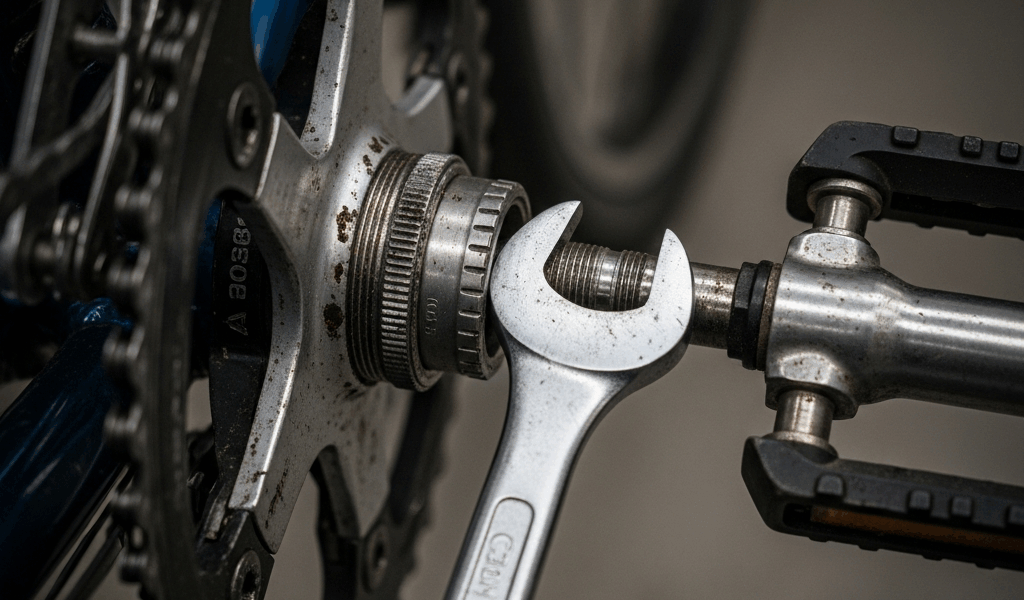
A creak near the bottom bracket does not prove the bottom bracket is bad. Noise travels through the frame, crank and seat tube, so loose pedals, crank hardware, chainring bolts, cleats, saddle rails or a rear axle can sound as though they come from the crank area. Diagnose the timing of the noise, check the simple external interfaces, and use the bicycle or component maker’s exact instructions before removing anything.
Stop riding and inspect the bike professionally if you see a crack, a separating bonded joint, movement between a bottom-bracket shell and the frame, a loose crank arm, damaged pedal threads, or unexplained play that cannot be corrected to the manufacturer’s procedure. A creak can be annoying, but it can also accompany a structural or installation problem.
Quick bottom-bracket creak diagnosis
| What you observe | Check first | Why |
|---|---|---|
| Noise once per pedal revolution | Pedals, cleats, crank attachment, chainring hardware and bottom bracket | These parts rotate or load with each crank cycle. |
| Noise only while seated | Saddle rails, seatpost head, seatpost/frame interface | Standing removes saddle and seatpost loading. |
| Noise while standing and pedaling hard | Pedals, crank, chainrings, bottom bracket, wheel axle and frame | The sound follows drivetrain or frame load rather than the saddle. |
| Noise while coasting | Wheels, brakes, hubs, frame or accessories | The crank and bottom bracket are not being driven. |
| Grinding, roughness or side-to-side crank play | Crank installation and bottom-bracket bearings | These symptoms are stronger evidence than sound alone. |
| Creak began after service | Every part disturbed during that service | Incorrect assembly, preparation or torque is more likely than a coincidental new failure. |
Step 1: reproduce the noise without guessing
Take a short, low-risk test ride away from traffic. Note whether the sound occurs once per crank revolution, only in one gear, only under heavy torque, only while seated, or even while coasting. Do not perform hands-off or extreme-load tests. A phone recording can help, but the timing and load conditions are usually more useful than apparent location.
If the sound changes with gear choice rather than crank position, inspect the chain, cassette, derailleur and chainline. If it continues while coasting, start outside the bottom bracket. Park Tool’s noisy-drivetrain troubleshooting guide likewise recommends isolating when a sound occurs and working through the system part by part.
Step 2: inspect before tightening
Clean enough dirt away to see the crank, bottom-bracket shell, chainrings, pedals and frame joints. Look for:
- a crank arm that moves relative to its spindle;
- side-to-side crank play;
- loose, damaged or cross-threaded pedals;
- missing hardware or a displaced crank safety plate;
- rust staining, fretting marks or gaps at an interface;
- cracks in the crank, frame or bonded bottom-bracket area; and
- a loose wheel axle or quick release.
Do not simply tighten every fastener harder. Torque differs by component and design. Find the bicycle, frame, crank and pedal model, then consult the current manufacturer manual. Shimano’s own two-piece crank instructions, for example, specify staged and alternating tightening for paired left-crank bolts on applicable models; that is different from the procedure for a square-taper, self-extracting or SRAM crank.
Step 3: rule out the common sound transmitters
Pedals and cleats
Check that each pedal is correctly threaded and secure, and inspect pedal bearings for play or roughness. The left pedal uses a left-hand thread; forcing it in the wrong direction can destroy the crank threads. Use the pedal or crank maker’s preparation and torque specification—not a universal number. On clipless shoes, inspect cleat bolts and the cleat-pedal interface. Do not ride a pedal that is loose in the crank because continued movement can damage the crank threads.
Crank attachment
Check for movement between each crank arm and spindle. The correct procedure depends on the crank type: square taper, splined three-piece, two-piece pinch-bolt, self-extracting and other systems are not interchangeable. Identify the system first. Park Tool’s crank identification guide routes each design to the appropriate method.
A crank ridden while loose may be permanently damaged even if its bolt can later be tightened. If the arm has wallowed on the spindle, the fixing bolt repeatedly loosens, or you are uncertain about the safety plate or preload procedure, stop and have a qualified mechanic inspect it.
Chainring hardware
With the bike stationary, check for loose or damaged chainring hardware using the crank maker’s instructions. Some modern direct-mount rings and power-meter assemblies require model-specific tools or procedures. Do not assume generic chainring-bolt advice applies.
Saddle and seatpost
If standing eliminates the creak, inspect the saddle rails, clamp and seatpost interface. Confirm the saddle clamp is assembled correctly and tighten it only to the printed or manufacturer-specified limit. Carbon components may require a particular assembly compound and lower torque; grease is not appropriate for every interface.
Axles and other frame contacts
Check that the wheels are correctly seated and that thru-axles or quick releases are secured according to the bicycle maker. Bottle cages, racks, derailleur hangers and cable contacts can also transmit noise. A clean interface-by-interface check is more reliable than replacing parts based on sound location.
Step 4: test for actual bottom-bracket symptoms
After ruling out external causes, remove the chain from the chainring only if you can do so safely without damaging the frame. Slowly rotate the crank and feel for grinding, notches or uneven resistance. Then check for lateral play at several crank positions. Chain drag and derailleur pulley noise can otherwise disguise bearing feel.
Roughness or play can indicate worn bearings, an incorrectly adjusted system, a loose cup or adapter, or a crank-installation problem. It still does not identify the exact standard. Park Tool’s bottom-bracket identification guide explains why visually similar systems can require different tools and procedures.
Threaded versus press-fit: why the distinction matters
A threaded bottom bracket screws into threads in the frame shell. Depending on the standard, thread direction differs, and tool engagement matters. A press-fit system uses bearings or cups pressed into a smooth bore. Some thread-together units fit inside a press-fit shell but have their own removal method.
Do not use a blanket “turn the drive side this direction” instruction until the shell and unit are positively identified. Italian, BSA/English, T47 and one-piece systems do not all behave alike. Likewise, do not strike out press-fit bearings with improvised tools: damage to the frame bore can turn a service job into an expensive frame problem.
When cleaning and reassembly may solve the creak
If inspection confirms the correct component and no part is worn or damaged, noise may come from movement at an inadequately prepared interface. The remedy may involve cleaning, inspecting, applying the manufacturer-specified grease, anti-seize, threadlocker or retaining compound, and reinstalling with the correct tool and torque sequence.
Those materials are not interchangeable. A retaining compound recommended for a specific press-fit fit problem is not a universal cure, and adding grease where a manufacturer specifies another preparation can make matters worse. Use the frame and component manuals together. If they conflict, ask the manufacturers or a qualified bicycle mechanic before proceeding.
When the bottom bracket should be replaced
Replacement is reasonable when the correctly installed unit has persistent bearing roughness, corrosion, play that cannot be adjusted out, a damaged seal or cup, or wear beyond its service specification. Many cartridge and sealed-bearing systems are replaced as assemblies or with specified bearing parts; adjustable cup-and-cone systems have a different service process.
Before ordering, record the frame shell standard and width, crank spindle interface and diameter, required spacers, chainline requirements, and exact component model. “Road,” “mountain,” “BB30” or spindle diameter alone may not be enough to establish compatibility.
What not to do
- Do not replace the bottom bracket solely because the noise seems to come from that area.
- Do not invent a universal torque for pedals, crank bolts or cups.
- Do not use an adjustable wrench as a substitute for the specified torque and interface tool.
- Do not force a threaded part whose direction or standard you have not identified.
- Do not sand, knurl, face or modify a frame interface without manufacturer-approved expertise.
- Do not continue riding a loose crank, damaged pedal thread or suspected frame crack.
Bottom-bracket creak checklist
- Record exactly when the noise occurs.
- Inspect for damage, looseness and play before tightening anything.
- Check pedals, cleats, crank attachment, chainrings, saddle/seatpost and wheel axles.
- Use model-specific torque and assembly instructions.
- Test bearing smoothness and lateral play with chain influence removed when safe.
- Identify the crank and bottom-bracket standard before removal.
- Stop and seek professional help for structural concerns, persistent looseness or uncertain compatibility.
For a separate overview of removal and replacement planning, see our bottom-bracket service guide. If the crank must come off, first identify its design and consult our crank-removal overview alongside the component maker’s manual.

Stay in the loop
Get the latest bike maintenance pros updates delivered to your inbox.