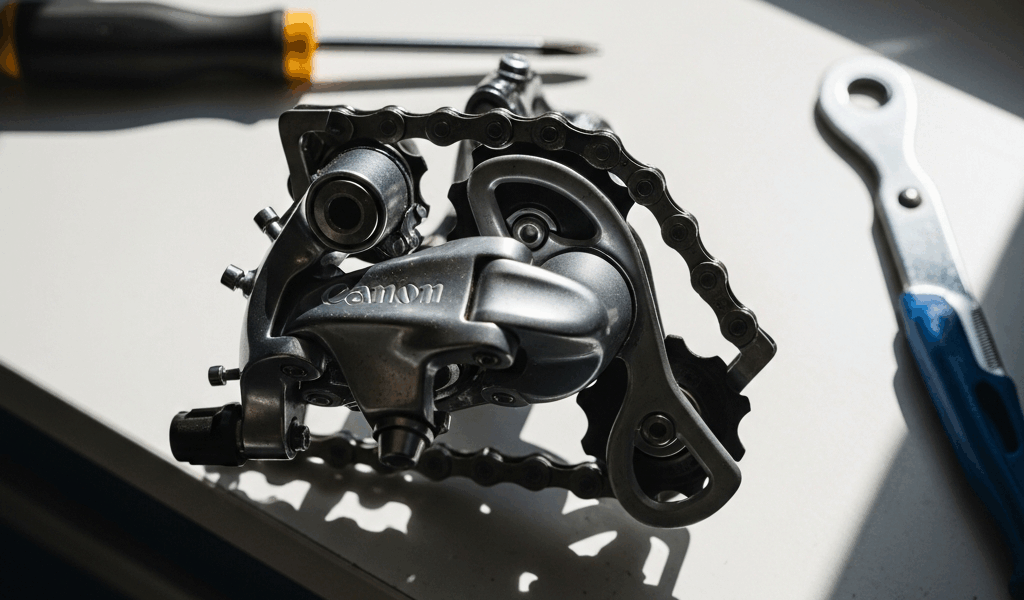
Why Decathlon Drivetrains Act Up Early
I bought a Triban RC500 three years ago. Within the first month, the rear derailleur started making this grinding noise whenever I shifted into the middle sprockets, and by 300 kilometers, it was skipping under load. My first instinct was to assume I’d bought a lemon. Then I talked to a Decathlon mechanic and learned the actual story — which has saved me hundreds in unnecessary parts since then.
Here’s the thing: Decathlon road bikes ship with competent budget drivetrains. The microSHIFT shifters and Shimano Claris or Sora derailleurs are not cheap garbage. They’re the same components you’ll find on entry-level bikes from Trek or Giant. But they ship with cable tension calibrated for the factory floor, not for your legs and your roads.
New brake and derailleur cables stretch. A lot. Probably should have opened with this section, honestly, because it’s the root cause of 80% of the complaints I see on Decathlon forums. That initial 50–100 kilometers eats up slack in the cable housing and the ferrules, and the shifter indexing drifts completely. The bike isn’t broken. The cable just needs tension adjustment.
Decathlon’s own in-store mechanics know this instantly. They build the bikes and they know the problem arrives fast. But if you’re opening the box at home and riding before the cable settles, you’re the one discovering the skip and the clunk.
Then there’s the derailleur hanger alignment issue. Triban frames use standard derailleur hangers — they’re not proprietary — but they’re mounted in a way that makes them vulnerable to shipping damage. A bent hanger of even 2 millimeters throws off the entire indexing geometry of the rear derailleur. You can’t fix that with a barrel adjuster. That’s a separate problem altogether.
Diagnose It — Match the Symptom to the Cause
Stop here and listen to what your bike is actually telling you.
Skipping under load (especially climbing). Either the chain is stretched, the cassette teeth are hooked, or the cable tension is loose. The derailleur sits too far from the sprocket and the chain falls between teeth instead of engaging.
Clunking or grinding on half your shifts. Usually the upshifts or only on certain sprockets — this signals indexing drift. The derailleur cable has stretched and the lever position no longer aligns with the sprocket spacing. This is the most common Decathlon complaint and it’s fixable in ten minutes.
Chain drops off the smallest sprocket or off the largest chainring? The limit screws need adjustment. These small screws on the derailleur body set the maximum and minimum range of derailleur travel. Shipping vibration can loosen them.
Grinding or scraping noise continuously, even on a straight line — usually means cross-chaining or a dry, dirty chain. Not a derailleur problem at all.
Write down which gears cause the problem. The small cogs? The big ones? All of them? Under load or just when pedaling lightly? That specificity matters because a cable-tension fix won’t fix a bent hanger, and a hanger replacement won’t fix a worn cassette.
Fix One — Rear Derailleur Indexing and Cable Tension
You need a screwdriver (Phillips head), a 4 mm or 5 mm Allen key, and the barrel adjuster on the derailleur cable stop. That’s genuinely it. No special tools required.
Start with the eyeball check. Shift into the middle of your cassette — say, the 6th sprocket on a 9-speed cassette. Look at the derailleur pulley from behind the bike. The pulley should sit directly under the sprocket, close enough that you could draw a vertical line through both. If the pulley is off to the side, the cable needs tension adjustment.
Locate the barrel adjuster. It’s a threaded collar where the cable enters the derailleur body, usually on the bottom or rear. Turn it counterclockwise by a quarter turn. This releases cable tension, moving the derailleur inward slightly. Shift up and down across all gears and listen. Still grinding on the same sprockets? Turn it another quarter turn counterclockwise. Keep going in quarter-turn increments until the grinding stops.
If you’ve turned it four full rotations and the derailleur still isn’t indexed, the cable stretch is too far gone or the cable is misrouted. Unscrew the cable anchor bolt (the 5 mm Allen key), pull the cable completely free from the derailleur, and re-seat it with fresh tension. Turn the barrel adjuster back to the middle of its travel — about 2–3 turns in from fully closed. Pull the cable tight with pliers, tighten the anchor bolt, and re-index with the barrel adjuster as above.
Do this on a stand or while someone holds the bike still. Shift slowly and deliberately between each adjustment. The derailleur needs a second to settle.
One more step: check the limit screws. There are two — usually marked H (high) and L (low). Shift into the smallest sprocket and look at the pulley position. If it’s rubbing the cassette or about to, turn the H screw clockwise just enough to create one millimeter of clearance. Shift into the largest sprocket and do the same with the L screw. These prevent the chain from derailing off the cassette edges.
Fix Two — Chain and Cassette Wear Checks
Skipping under load is often not cable tension at all. It’s a stretched chain or a worn cassette, and the two are connected.
Chains stretch. After 500 to 1000 kilometers on a budget drivetrain, a chain elongates enough to cause skipping — especially if the cassette has started to wear. The sprocket teeth develop a hook shape as they wear. The leading edge gets sharp and the back edge slopes. A stretched chain catches on the hook instead of gripping the tooth properly.
Buy a chain checker tool. They cost £3 to £8 and they’re foolproof. Hook it onto the chain and let it hang. If it drops all the way down between two links, the chain is stretched past safe limits. Replace it immediately. If the checker sits on top of the links, the chain is still good.
No checker handy? Use a ruler. Measure 24 links of chain (from pin center to pin center, 24 full links). A new chain measures exactly 12 inches or 304.8 millimeters. A stretched chain measures 12.1 inches or more. Beyond that, replace it.
After you install a new chain on an old cassette, the new chain will still skip because the cassette teeth are worn to the old chain’s shape. People get confused here — they think the new chain is faulty. It isn’t. The cassette is simply out of spec. A Shimano Sora 9-speed cassette costs £20 to £35 at Decathlon. Claris cassettes are even cheaper.
Here’s what matters: Decathlon cassettes are standard Shimano-compatible parts. You’re not locked into a proprietary ecosystem. Any 9-speed or 10-speed cassette from any brand will work on your Triban or Van Rysel as long as the freehub speed matches. Most Decathlon road bikes come with either 9-speed Sora or 10-speed Claris, and both are stamped clearly on the cassette.
When to Take It Back to the Decathlon Workshop
Decathlon’s in-store workshops offer a free first service within the first 30 days of purchase. This service includes cable tension adjustment, limit screw tweaking, and basic indexing. If your bike is still under 30 days and it’s skipping, take it in. They’ll fix it for free and it saves you the diagnosis work.
Beyond the first month, a basic rear derailleur tune-up costs around £20 to £25 at most Decathlon service counters. A full drivetrain service including chain and cassette inspection runs £40 to £60. Fair prices, honestly.
Two failures are worth escalating to Decathlon’s workshop instead of fixing yourself. First: a bent derailleur hanger. If your derailleur is hitting the cassette even after full cable tension adjustment and limit screw tweaking, the hanger is likely bent. A hanger alignment tool costs £30 to £100 and that’s not a home-mechanic purchase. Decathlon staff can check it with their tools and replace it if needed. It’s usually covered under the first-month warranty.
Second: a shifter that feels mushy or won’t click cleanly into positions. Shifters are sealed units and they can’t be repaired at home. If clicking the lever doesn’t produce a crisp engagement — if it feels spongy or slow to return — the shifter internals are likely damaged. This isn’t common, but it happens occasionally on shipping. Bring it back.
Everything else — cable tension, cassette wear, chain stretch, limit screw drift — you can handle with home tools and 20 minutes of patience. Decathlon sells the right parts and they’re cheap enough that replacing a chain or cassette before your first big event is a preventive expense, not a catastrophe.
The drivetrain problems you’re seeing aren’t design flaws. They’re normal behavior of new budget components settling in under load. Catch them early, adjust the cable, and your Decathlon road bike will run cleanly for thousands of kilometers.

Stay in the loop
Get the latest bike maintenance pros updates delivered to your inbox.