Your disc brakes are making that maddening scraping sound with every wheel rotation, and you just want it to stop. The fix depends entirely on what’s causing the rub — and there are six common culprits. I’ll walk through each one so you can pinpoint yours and sort it out without guessing.
Identify Which Type of Rub You Have
Before touching anything, spin your wheel and listen. The rub pattern tells you almost everything:
Constant rub — the brake drags throughout the entire rotation. This points to a caliper alignment issue or pads sitting too close to the rotor.
Intermittent rub — you hear it once per wheel revolution at the same spot. Classic bent rotor. The warp catches the pad at one point in the rotation.
Rub only after removing and reinstalling the wheel — the axle isn’t fully seated or the rotor shifted position relative to the caliper. This is the most common scenario and usually the easiest to fix.
Sudden rub after a fall or crash — bent rotor from impact. Even a gentle lean against a wall can bend a rotor if contact hits the right spot.
Gradual rub that developed over time — pad wear or rotor wear has changed the clearances. The gap between pad and rotor is measured in fractions of a millimeter, so even small wear changes things.
Cause 1 — Caliper Alignment (The Most Common Fix)
If you just reinstalled your wheel or the rub is constant on both sides, caliper alignment is the first thing to check. This fix takes about two minutes and no special tools.
Loosen the two caliper mounting bolts — just enough that the caliper can slide side to side on its mount. Don’t remove them entirely. Now squeeze the brake lever firmly and hold it. While the lever is squeezed (this centers the caliper around the rotor), tighten both mounting bolts back down. Release the lever. Spin the wheel.
That clears up about 70% of disc brake rub complaints right there. If it didn’t work on the first try, loosen and repeat — sometimes one bolt needs to be snugged before the other to get the caliper seated properly. If the rub persists after two or three attempts, you’re dealing with something else on this list.
Cause 2 — Bent Rotor
Spin your wheel slowly and watch the rotor pass between the brake pads. If you see it deflect toward one side at a consistent point in the rotation, the rotor is warped. Even a bend of half a millimeter is enough to cause audible rub.
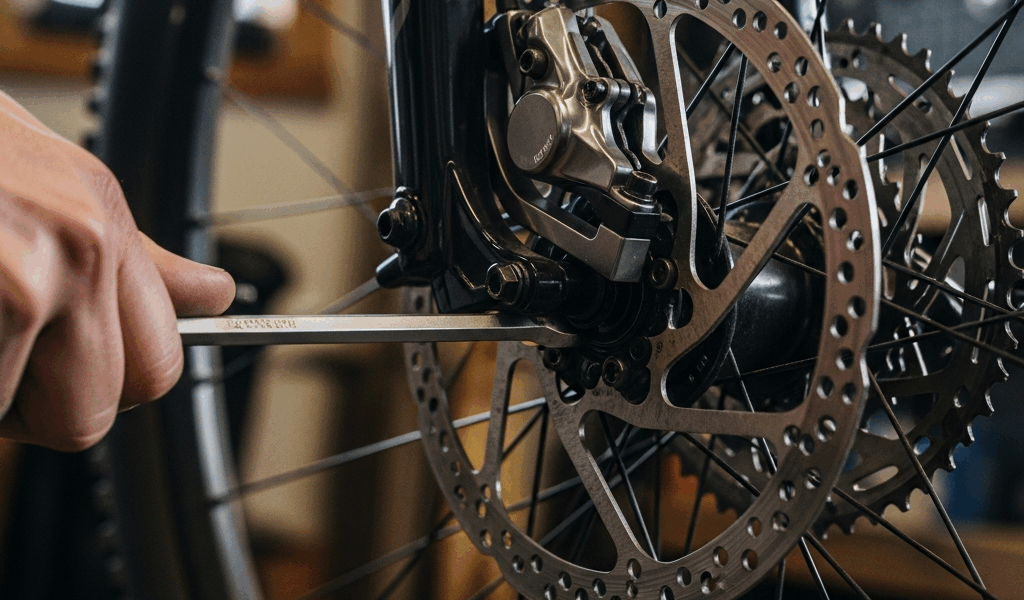
For minor bends, a rotor truing tool like the Park Tool DT-2 lets you apply precise pressure to straighten the warp. If you don’t have one, a clean adjustable wrench works — grip the rotor at the bend point and apply gentle, controlled pressure. The metal is relatively soft and responds to careful manipulation. Go slow. Over-bending creates a new warp in the opposite direction, which is frustrating.
For severe bends — anything you can see without spinning the wheel — just replace the rotor. A new one costs $15 to $40 depending on the model, and fighting a badly warped rotor isn’t worth the aggravation.
Cause 3 — Contaminated Brake Pads
Oil on disc brake pads is a one-way trip. Chain lube overspray, fingerprints on the rotor surface (yes, skin oil counts), or any petroleum product that contacts the pad face will compromise braking and can cause inconsistent pad contact that produces rubbing sounds.
The bad news: contaminated pads can’t be reliably cleaned. You can try sanding the surface and baking them in an oven (some mechanics swear by this), but replacement is the only guaranteed fix. Brake pads are $10 to $25 per set — cheaper than the crash you’ll have if contaminated pads fail on a descent.
Prevention matters here. Never touch rotor surfaces with bare hands. When applying chain lube, cover the rotor with a rag or piece of cardboard. It takes five seconds and saves you a pad replacement.
Cause 4 — Worn Pads or Rotor
Brake pads at minimum thickness (roughly 1mm of pad material remaining) force the caliper pistons to extend further than they’re designed for. The pad contacts the rotor at odd angles, producing rub and reduced stopping power.
Check your pad thickness by looking into the caliper slot — most pads have a wear indicator groove that disappears when they’re due for replacement. If the groove is gone, swap them out.
Rotors have a minimum thickness too, usually stamped directly on the rotor surface (1.5mm or 1.8mm is typical). A thin rotor flexes more under braking pressure, which makes it more prone to warping — and that warp causes the intermittent rub we talked about earlier. If your rotor is at or below minimum thickness, replace it alongside the pads.
Quick-Fix Sequence for Post-Wheel-Reinstall Rub
Just took your wheel off and put it back, and now the brakes are rubbing? This three-step sequence solves it about 90% of the time and takes under five minutes:
1. Make sure the axle is fully seated. If you’re running a quick-release, the skewer should be tight enough that you feel resistance at the lever’s halfway point. For thru-axles, torque to the spec stamped on the axle (usually 12-15 Nm).
2. Do the caliper re-centering procedure. Loosen both mounting bolts, squeeze lever, hold, retighten bolts, release lever.
3. Spin the wheel. If the rub is gone, you’re done. If you still hear intermittent contact, inspect the rotor for a slight bend and true it.
If those three steps don’t solve it, the problem is deeper — contaminated pads, worn components, or a damaged caliper mount. But nine times out of ten, steps one and two are all you need.

Stay in the loop
Get the latest bike maintenance pros updates delivered to your inbox.