
Why Your Chain Skips Under Load But Not When Coasting
Bike drivetrain troubleshooting has gotten complicated with all the conflicting advice flying around. As someone who spent three years ignoring a clicking noise before finally tearing into my drivetrain properly, I learned everything there is to know about chain skip under load. Today, I will share it all with you.
Most riders assume they need a new chain. Some go straight for a cassette. A few replace both — then still have the exact same problem. That was me, actually. Dropped $45 on a new chain, rode it for two weeks, still felt that gut-punch jolt every time I hammered out of a corner.
So what actually causes it? When you push hard on the pedals, the chain tightens and tries to climb the cassette teeth. If those teeth have worn into a hooked shape — or the chain itself has stretched — it skips backward momentarily before catching. You feel a sudden jolt. Sometimes you hear a distinct skip-click. It’s unmistakable once you know what you’re listening for.
But what is chain skip, really? In essence, it’s the chain losing grip on a gear tooth under tension. But it’s much more than that. It’s mechanically different from ghost shifting, where the derailleur tosses the chain between gears on its own, and it’s nothing like a limit screw issue, where the chain overshoots the smallest or largest cog entirely. The load-only pattern narrows your culprits down to three things: stretched chain, hooked cassette teeth, or a bent derailleur hanger killing your chain line. That’s it.
That’s what makes diagnosing this endearing to us home mechanics — it’s actually a contained problem. So, without further ado, let’s dive in.
Step 1 — Check Chain Wear First
Probably should have opened with this section, honestly. The chain is the cheapest part and the most common reason for skip. Start here before you touch anything else.
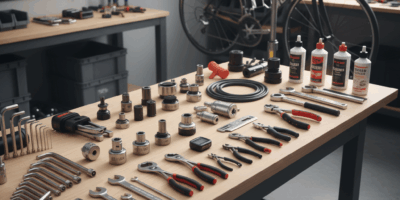
While you won’t need a full workshop setup, you will need a handful of basic tools — and a chain checker is the one that matters most right now. Park Tool’s CC-3.2 runs about $12 at any bike shop and it’s the industry standard. Slide it onto the chain while the bike sits in the small ring. The tool has two notches: 0.5% wear and 0.75% wear. If the chain drops into the 0.5 notch, it still has life. If it falls into the 0.75 notch, you’re replacing it before anything else gets diagnosed. Hangs loose past both notches? That chain is absolutely shot.
No chain checker yet? Use the pull-away test instead. Grab the chain where it runs over the smallest chainring and pull it away from the ring. More than a quarter-inch of gap means stretch. Half an inch or more — it’s done, no question.
I’m apparently a chronic over-miler with chains and the CC-3.2 works for me while eyeballing the wear never does. Don’t make my mistake. The tool costs less than a cup of coffee twice over.
As a rough timeline: most drivetrains want a fresh chain somewhere between 1,500 and 2,000 miles. Wet conditions year-round? Closer to 1,200. Obsessive dry-weather maintenance? Maybe 2,500. A chain that has already been skipping under heavy load is almost always past 0.75% stretch — in my experience, without exception.
Step 2 — Inspect the Cassette for Shark Fin Teeth
Once you have a number on chain wear, look at the cassette. This is where most people fail the diagnosis and end up buying parts twice.
Worn cassette teeth have a signature look. Not blunt. Not rounded. They develop an asymmetric hook — like a tiny shark fin leaning forward on the drive side of the cog. The tooth ramps between adjacent teeth go shiny and polished. Everything looks like it’s about to climb over itself.
Spin through the cassette slowly. Check the middle cogs first — the 15, 17, 19-tooth range on a typical 11-speed — because that’s where most riders spend most of their time. The 11 or 12-tooth small cog actually wears slower. Higher tension, less time spent there. Ironic, but true.
Here’s the critical rule: hooked teeth and a new chain is a bad combination. A fresh chain on worn cogs feels worse initially — the tighter tolerances catch on the hooks and the skip can actually increase for the first 50 miles while things wear in together. Then you’re back here thinking the replacement failed. It didn’t fail. You just skipped the cassette inspection.
Visibly hooked teeth mean you’re replacing both the chain and the cassette. End of story. If the cassette teeth look clean and sharp and the chain measures under 0.5% wear, you can reuse it — but hooked teeth mean the cassette is done regardless of what the chain checker says.
Step 3 — Check the Derailleur Hanger for a Bend
This step gets skipped most often. A bent hanger doesn’t cause constant skipping across every gear, which is exactly why it hides so well.
Frustrated by skip that seemed to only hit specific cogs, I finally stood behind my bike and actually looked at the derailleur pulley cage relative to the cassette. It should be perfectly parallel. Mine wasn’t — tilted maybe 3 millimeters inward toward the spokes. That was 2019, and I’d been chasing that skip for four months.
A bent hanger concentrates skip in the smallest cogs — the 11, 12, and 13-tooth range — or it shows up specifically on the big chainring. If your skip happens across every gear under load, this probably isn’t your problem. But if it’s gear-specific, sight along the derailleur from behind the bike. Tilted inward toward the spokes or canted outward away from the wheel? Bent hanger.
The Park Tool DAG-2 alignment gauge is the proper tool here — around $60. A straight-edge held against the derailleur body works in a pinch. A replacement hanger runs $15 to $40 depending on your frame manufacturer. Straightening works if the bend is minor, but replacement is almost always the safer call. Hangers are meant to be sacrificial.
The Fix — What to Replace and in What Order
By now, the diagnosis should be clear. Here’s the replacement logic:
- Chain only: if the chain measures over 0.75% wear and the cassette teeth still look clean and sharp
- Chain and cassette together: if the cassette has hooked teeth, regardless of what the chain checker reads
- Derailleur hanger: if skipping is gear-specific or the hanger is visibly out of parallel with the cassette
- Cable check: after any replacement, pull the derailleur cable tight and verify tension — a stretched cable mimics chain skip symptoms and can quietly destroy six months of drivetrain life if nobody catches it
One last thing worth knowing: 11-speed and 12-speed drivetrains are dramatically more sensitive to wear than older 9 or 10-speed setups. The teeth are smaller, tolerances are tighter, and worn components announce themselves faster. If you’re running modern gearing — SRAM Eagle, Shimano XT 12-speed, anything in that world — this diagnosis path isn’t optional. It’s just part of ownership.
This is a common repair. Any home mechanic with a set of hex wrenches and about thirty minutes can handle the whole thing. You’ve got this.



Stay in the loop
Get the latest bike maintenance pros updates delivered to your inbox.